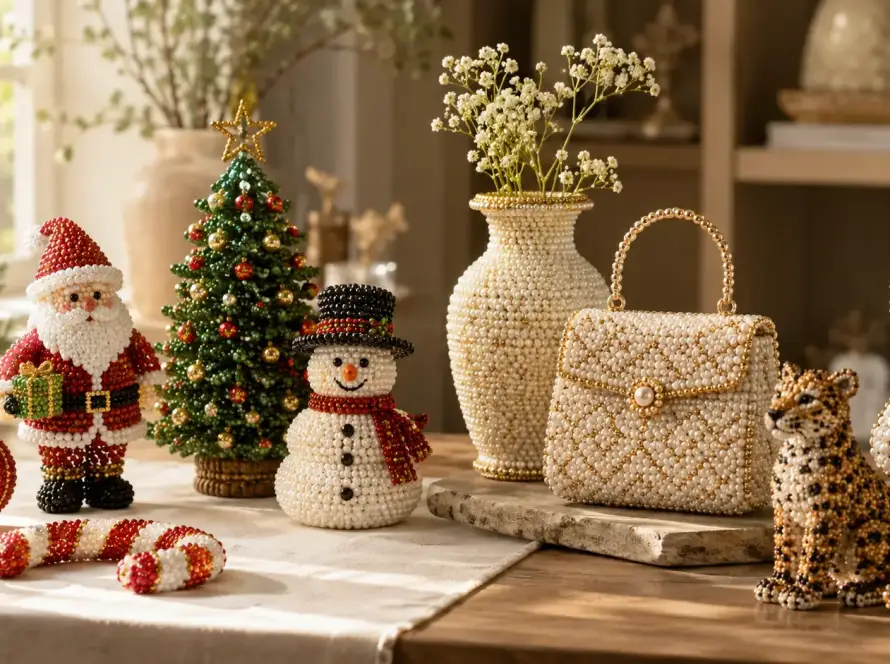
Every year, the same story plays out in gift shops and home decor boutiques: the Christmas display looks a little thin by the second week of December, and the supplier that could have saved the season is already sold out. For retailers who depend on seasonal handmade goods, ordering Christmas craft supplies is not something you figure out in October. It is a calendar decision, a supplier decision, and a merchandising decision made months in advance.
This guide walks through when to place your orders, what categories of Christmas stock actually move off the shelf, and how to choose a supplier of handmade Christmas craft supplies who can deliver quality without blowing your lead time. Whether you run a gift shop, a home decor boutique, a hospitality gift counter, or an online craft store, the same planning principles apply.
I. Why Christmas Ordering Timing Matters for Retailers
Christmas is the single biggest revenue window most gift and decor retailers see all year, and it is also the most unforgiving. Unlike a year-round SKU, a Christmas ornament or decorative piece has one real selling season. Miss the window and that inventory sits in a back room until the following year’s holiday season, tying up cash that should be working for you right now.
Timing matters for three practical reasons:
- Lead times are longer than they look. Overseas production and shipping take time. Handmade goods, in particular, cannot be rushed the way machine-stamped items can — skilled artisans work at a natural pace, and quality suffers when factories try to compress that timeline.
- Peak demand starts earlier than the calendar suggests. Shoppers start browsing holiday displays as early as October. If your shelves are still bare, you have already lost the early-bird segment of your customer base to a competitor who planned ahead.
- Late stock costs money twice. Seasonal inventory that arrives late is a double loss: the freight premium for rushed shipping, and the markdown you take to clear unsold stock in January.
There’s also a growing demand side to consider. Shoppers are increasingly drawn to handmade and small-batch decor over mass-produced plastic, which means well-timed Christmas craft supplies sourcing does double duty: it protects your calendar and lets you meet a trend that shows no sign of slowing down.
Retailers who treat Christmas craft supplies sourcing as a year-round task, rather than a fourth-quarter scramble, consistently see better sell-through and fewer emergency reorders.
II. The Retailer's Christmas Ordering Calendar
There is no universal deadline that works for every retailer, but the rhythm below is a reliable framework whether you are sourcing from a local craft workshop or a factory overseas.
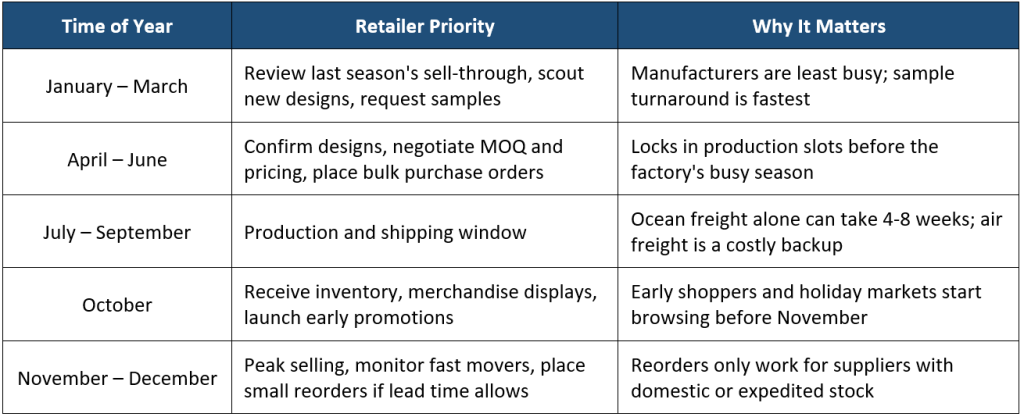
Sourcing From Overseas? Build In a Buffer
If you are sourcing Christmas craft supplies from China specifically, add extra cushion around the April–June window. Chinese New Year (typically January or February) and the run-up to it can compress factory capacity, and many workshops that produce beaded and other handmade goods take on limited seasonal labor, so early commitment matters even more.
A simple way to stay on schedule is to work backward from your in-store date. Decide when you need stock on the shelf, subtract your carrier’s realistic transit time, then subtract production time and sample approval — whatever is left is your order-placement deadline, not the other way around.
III. What to Stock: Core Christmas Craft Categories
A strong Christmas assortment is not one hero product — it is a mix of categories that give shoppers reasons to browse, gift, and add one more small item to their basket. The table below outlines the categories that consistently perform well across gift shops, home decor stores, and hospitality retail counters.
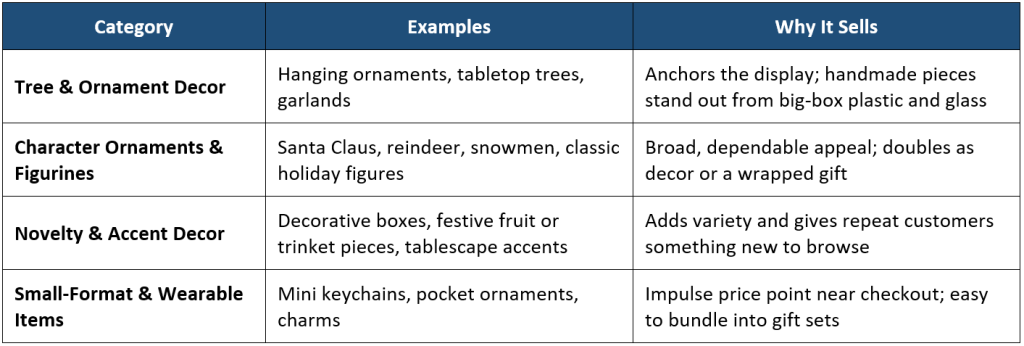
The common thread across all four categories is that handmade Christmas craft supplies photograph better, feel more premium in hand, and carry a story — “handcrafted,” “beaded by hand,” “small-batch” — that mass-manufactured decor simply cannot match. That story is what customers are increasingly willing to pay a little more for.
IV. Choosing the Right Product Mix for Your Store
Stocking every category evenly is rarely the right call. The best mix depends on who walks through your door.
- Match assortment to your customer base. Gift shops and boutiques tend to do well leaning into character ornaments and novelty pieces that make natural gifts under $20.
- Home decor vs. gift-focused stores. Home decor retailers should weight toward larger tree pieces and tabletop centerpieces that customers buy to keep, not to give away.
- Hospitality and corporate buyers. Hotels, restaurants, and event venues often order in bulk for seasonal displays and staff or client gifts, and they value consistency across a large order more than variety.
- Balance hero pieces with small-ticket add-ons. A good rule of thumb is roughly 60% dependable, repeat-selling staples (classic ornaments, trees) and 40% newer or novelty pieces that test what next year’s bestseller might be.
It also pays to look backward before you look forward. Your own point-of-sale data from last season is the most reliable guide you have — the designs, colors, and price points that sold out first are usually worth reordering in greater volume, while slow movers are a signal to swap in something new rather than restock automatically.
Whatever the split, resist the temptation to order one of everything. A tighter, well-curated selection of Christmas handicraft supplies almost always outsells a scattered assortment, because it is easier for customers to browse and easier for you to restock the winners.
V. Working with a Manufacturer: What Retailers Should Ask
Sourcing decisions made in the first conversation with a supplier tend to determine how smooth — or stressful — your entire season turns out to be. Before committing to a bulk order, ask these questions:
- Do they offer custom Christmas craft supplies or OEM options? Can they produce a small trial batch or a private-label version so you can test sell-through before scaling up?
- Is a sample available before you commit to a full order? A manufacturer who won’t send a physical sample before a bulk order is a red flag, not a cost-saving shortcut.
- What is the minimum order quantity (MOQ)? Confirm minimum order quantity, and ask whether it flexes for a first-time or trial order.
- What is the true lead time, door to door? Get a realistic production timeline plus shipping method and transit time, not just a production date.
- How is quality controlled across a handmade batch? Handmade items naturally vary — ask how the supplier maintains consistency in color, size, and finish across a large batch.
- What are the shipping and payment terms? Clarify who handles freight, insurance, and customs at each stage (FOB, EXW, or DDP) so a shipping surprise doesn’t erase your margin.
A supplier who answers these questions clearly, without vague promises, is usually the one worth building a long-term relationship with — especially for a category like Christmas handcraft supplies, where quality is harder to verify from photos alone.
VI. Avoiding Common Ordering Mistakes
Even experienced retailers fall into a handful of predictable traps each Christmas season:
- Ordering too late. Waiting until September to place a bulk order all but guarantees you’ll miss October shelf-stocking, and possibly the whole season if production runs behind.
- Over-committing to a single product. Betting everything on one design leaves you exposed if it underperforms and gives customers no reason to browse further.
- Skipping samples to save time. Skipping the sample stage to save a few days almost always costs more time later, once a full container arrives with an issue you could have caught early.
- Ignoring lead time and MOQ when comparing quotes. A supplier’s lowest unit price is meaningless if their lead time doesn’t fit your calendar, or their MOQ locks up more capital than you can safely tie into seasonal stock.
- Forgetting duties and customs delays. Import duties, customs clearance, and inland freight can add real cost and days to your timeline — build both into your budget and your calendar before you order, not after.
Most of these mistakes trace back to the same root cause: treating Christmas craft supplies as a last-minute purchase instead of a planned, multi-month sourcing project.
VII. Recommended Supplier of Beaded Christmas Craft Supplies
Stocking a strong Christmas assortment comes down to two decisions made well before the holiday rush: ordering early enough to absorb production and shipping realities, and choosing a mix of products that gives your customers real reasons to buy. Whether you’re sourcing beaded ornaments, textile decor, or any other category of Christmas handiwork supplies, the retailers who plan their calendar in January are the ones celebrating strong sell-through in December.
Start the conversation with your suppliers early, ask the right questions, request samples before you commit, and build an assortment that balances dependable staples with fresh, giftable pieces. Do that, and your Christmas display will be the one still looking full — and still selling — right up to the last shopping day before the holiday.
If beaded decor fits into your Christmas assortment, Obeado Crafts Co., Ltd. is worth a look. Based in Guangxi Province, China, Obeado has been manufacturing handmade beaded crafts for over 15 years, growing from a small workshop founded in 2011 into a dedicated factory that supplies gift shops, home decor retailers, and hospitality buyers around the world.
Their Beaded Christmas Crafts line covers the categories retailers ask for most: beaded Christmas trees in multiple sizes, hanging ornaments, Santa Claus and reindeer figures, novelty pieces like beaded pumpkin boxes and apple decor, and small-format items such as mini tree keychains that work well as add-on sales at checkout.
Obeado Crafts Co., Ltd.
Web: https://obeado.com/
Email: sales@obeado.com