Search “beaded crafts wholesale” and you’ll get flooded with suppliers all making the same promises: low MOQ, competitive pricing, custom orders welcome. But look closer and you’ll find two very different kinds of businesses behind those listings — a craft company and a craft factory. The terms get used almost interchangeably, and most buyers never stop to ask which one they’re actually emailing.
That’s worth sorting out early, because the difference doesn’t stay theoretical for long. It shows up in your margins, your lead times, and how much real control you have over what eventually lands in your warehouse. This guide walks through what separates a craft company from a craft factory, the signs that tell you which one you’re dealing with, and how to decide which model actually fits the way your business buys.
Quick answer:
A craft company is a trader that resells goods made by other workshops — convenient for a broad, mixed product mix, but priced with a markup and limited on customization. A craft factory owns its own production, so you get factory-direct pricing, tighter quality control, and real OEM/custom options — with a narrower product specialty in return.
I. What Is a Craft Company (Trading/Reseller Model)?
A craft company, in most cases, is a trading business rather than a producer. It doesn’t run a workshop or employ artisans directly — instead, it sources finished goods from a network of smaller workshops, sometimes dozens of them, and resells everything under one catalog or brand name.
For buyers, this model has genuine upside. A trading company can offer a wide product range — beaded bags one month, seasonal ornaments the next — without you having to manage several supplier relationships at once. If you’re placing a smaller order across a few unrelated categories, that convenience is worth something.
Where the trade-offs show up
- Pricing: every trader adds a margin on top of what the actual maker charges, and that markup stacks if more than one layer sits between you and production.
- Quality control: since the goods come from different workshops, consistency between batches — and sometimes within the same order — can vary more than buyers expect.
- Customization: a reseller can only pass your request along to whichever workshop happened to make that item, which usually means slower turnaround and less say over the final result.
II. What Is a Craft Factory (Manufacturer Model)?
A craft factory, by contrast, owns or directly manages the actual production — the workshop, the materials, and, for handmade goods especially, the artisans doing the work. Order from a factory and you’re buying straight from the source, with no reseller sitting in between.
This is the model behind terms like “handmade craft factory” or “custom craft factory,” because owning production is what actually makes real customization possible. A factory can adjust bead colors, sizing, packaging, or design details at the source, instead of relaying your request to a third party and hoping it comes back right.
Where the advantages show up
- Pricing: factory-direct, with no reseller markup layered on top.
- Quality control: tighter, because the same hands and the same standards apply to every batch.
- Communication: faster answers on production questions, because you’re talking to the people who actually know the process — not relaying a question up a chain.
There is one fair trade-off worth naming: a factory is usually more specialized than a trading company. A beaded crafts factory makes beaded crafts — not candles, not ceramics — so if you need a very broad, unrelated product mix from a single supplier, sourcing purely from factories means managing more than one relationship.
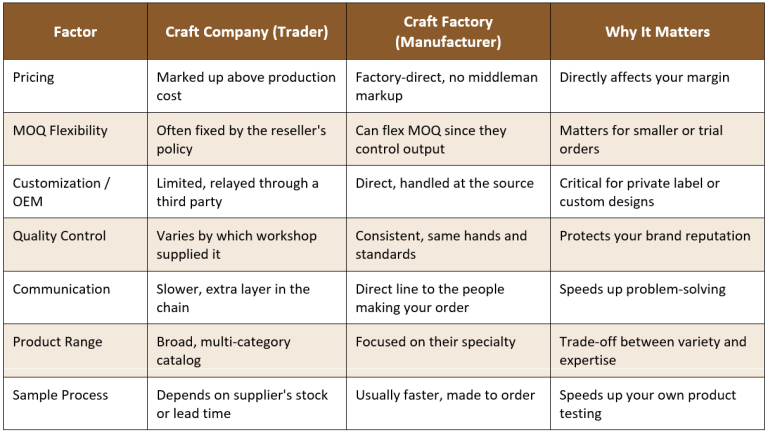
III. Key Differences at a Glance
Here’s a quick side-by-side, useful as a checklist the next time you’re comparing a craft manufacturer against a trading company for a new order.
IV. Red Flags That You're Talking to a Reseller
Suppliers rarely announce that they’re trading companies — you have to read between the lines. Watch for:
- Vague or deflecting answers when you ask directly about “your factory” or production location.
- No real photos or video of an actual workshop — only product shots, or stock imagery that shows up on other sites too.
- MOQs that never move, even for repeat customers or larger volumes, which suggests they’re bound by someone else’s policy, not their own.
- Pricing that barely changes at scale, since there’s no production cost for them to leverage against volume.
- Customization requests that come back slow, altered, or declined outright, because the request has to pass through a maker they don’t directly manage.
V. Signs You've Found a Real Craft Factory
On the flip side, a genuine craft manufacturer usually makes itself easy to verify:
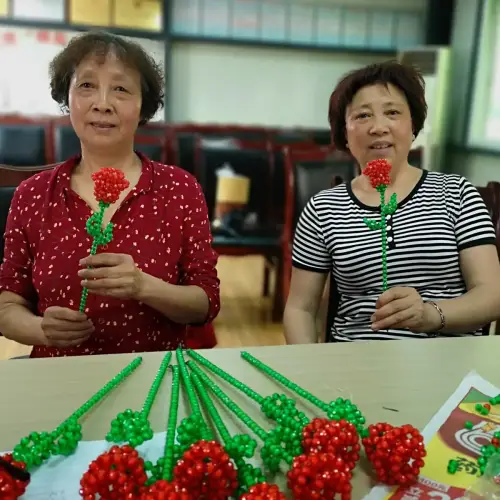
- They can show or arrange a look at the actual workshop — photos, video calls, or even a factory visit if you’re in the region.
- Samples are offered before you commit to a bulk order, and turnaround on samples is fast because they’re made in-house.
- MOQs are flexible, because the factory controls its own production schedule rather than working around someone else’s minimums.
- OEM and customization requests — colors, sizes, packaging, private labeling — are handled directly and confidently, not passed along and hoped for.
- Their company story holds together: a founding date, a real production history, and specifics about who’s actually making the products.
VI. Which One Is Right for Your Business?
There isn’t a universally “better” option — it depends on what you’re buying and how you buy it.
A craft factory is the stronger fit if you need custom or OEM designs, want the best possible pricing at volume, care about consistent quality order after order, or are looking to build a long-term sourcing relationship rather than a one-time purchase.
A trading company may still make sense if you need many unrelated product categories bundled into a single order, you’re placing a very small one-off purchase, or customization simply isn’t part of your plan. For most retailers, hotels, gift shops, and event businesses building a recurring product line, though, sourcing straight from a craft factory tends to pay off in pricing, consistency, and how quickly problems get solved.
VII. Frequently Asked Questions
Q: Is a factory always cheaper than a trading company?
Usually, at least at the production-cost level — a factory has no reseller margin to add. But a trader placing large, consolidated orders across several workshops can sometimes negotiate volume pricing that offsets part of its markup, so it’s worth comparing quotes rather than assuming.
Q: Can a trading company still offer good quality?
Yes — plenty of reputable trading companies vet their workshops carefully. The risk isn’t that quality is automatically worse, it’s that consistency is harder for them to guarantee across different makers and batches.
Q: How do I confirm a supplier actually owns its factory?
Ask for a live video walkthrough of the workshop, request samples made in-house rather than pulled from stock, and see whether they can answer specific production questions (materials, timelines, capacity) without needing to check with someone else first.
Q: Does working with a factory mean I lose flexibility on product range?
Somewhat — a factory specializes in what it makes. Many buyers solve this by using a factory for their core, recurring product line and a trading company for smaller, one-off categories outside that specialty.
VIII. Recommended Beaded Craft Factory
“Craft factory” and “craft company” might sound like two names for the same thing, but they describe fundamentally different ways of doing business — and that difference reaches your pricing, your quality control, and how much flexibility you actually get. Before you commit to a new supplier, ask the direct questions: Who’s making this? Can I see the workshop? Can you actually customize this design, or are you just asking someone else to?
The answers will tell you which kind of partner you’re working with — and whether it’s the right one for how your business sources.
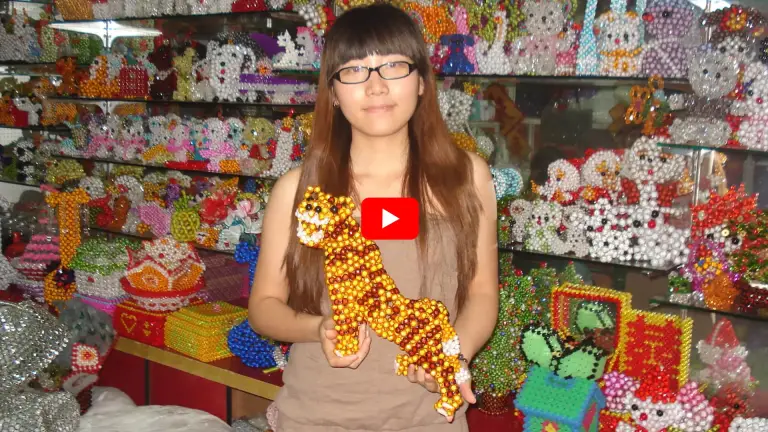
Obeado Crafts Co., Ltd. is a good example of what a real craft factory looks like in practice. The company, based in Guangxi Province, China, started in 2011 as a one-person handmade bead workshop: founder Maggie Wong trained under artisan masters in Xi’an for six months before setting up shop herself.
As a craft supplier, Obeado works the way a factory should: samples are available before you commit to a bulk order, MOQs stay flexible rather than fixed, OEM and custom design requests are handled in-house, and pricing reflects factory-direct production rather than a reseller’s markup. For buyers comparing craft factory sourcing options, that combination — a verifiable production history, direct artisan relationships, and genuine customization — is exactly what separates a manufacturer from a trader.
Obeado Crafts Co., Ltd.
Web: https://obeado.com/
Email: sales@obeado.com