In this guide:
- Why beaded home decor is accelerating heading into 2027
- Five trends worth stocking, with retail takeaways for each
- A quick-reference table mapping trends to product types and buyers
- What to ask any supplier before placing a wholesale order
- Where to source it from a manufacturer built for retail buyers
Walk the aisles of any home goods trade show this year and one thing stands out: beads are back, and they’re not the friendship-bracelet kind from a decade ago. Sculptural, tactile beaded pieces are showing up on tabletops, shelves, and gift displays, and retailers who stock them early are finding they move faster than expected. Beaded home decor has quietly shifted from a bohemian niche into a category buyers now search for by name.
For independent gift shops, boutique home stores, and multi-location chains alike, 2027 looks like the year beaded decor stops being a “maybe” and becomes a shelf staple. The appeal is simple: these pieces are handmade, texturally rich, and impossible to mistake for a mass-produced resin knockoff. They photograph beautifully, they carry a story, and shoppers will pay more for something a machine didn’t stamp out in bulk.
This guide walks through five beaded decor trends worth stocking ahead of the curve, what to ask before you place a wholesale order, and how to find a manufacturer who can actually deliver at scale.
I. Why Beaded Decor Is Having a Moment in 2027
A few forces are pushing beaded home decor into the mainstream at once, and it’s worth understanding all three before you decide how much shelf space to give the category.
- Interior design has swung back toward maximalism. After several years of minimalism, “maximalism with intention” has taken over — layered textures, handmade objects, and pieces with visible craftsmanship. Beadwork fits that shift perfectly: no two pieces are ever perfectly identical, and that imperfection reads as quality rather than flaw.
- Social search has created real, measurable demand. Interior design accounts on Pinterest and Instagram keep surfacing beaded vases, trays, and ornaments as “get the look” pieces, and search interest for beaded home decor has climbed steadily alongside it. Retailers who carry the category are capturing demand that already exists rather than trying to manufacture it.
- There’s a competitive gap at big-box retail. Large chains are still dominated by ceramic, resin, and glass decor — categories with thin margins and heavy price competition. Beaded decor hasn’t been mass-adopted at that scale yet, which leaves independent and boutique retailers room to carry something genuinely differentiated, at a healthier margin, before the category gets crowded.
2027 Beaded Home Decor Trends at a Glance
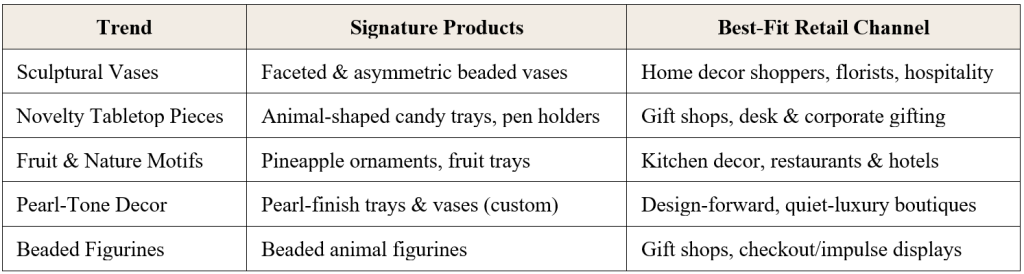
Here’s a closer look at each trend, and how to think about merchandising it.
II. Trend 1 — Sculptural Beaded Vases as Table Centerpieces
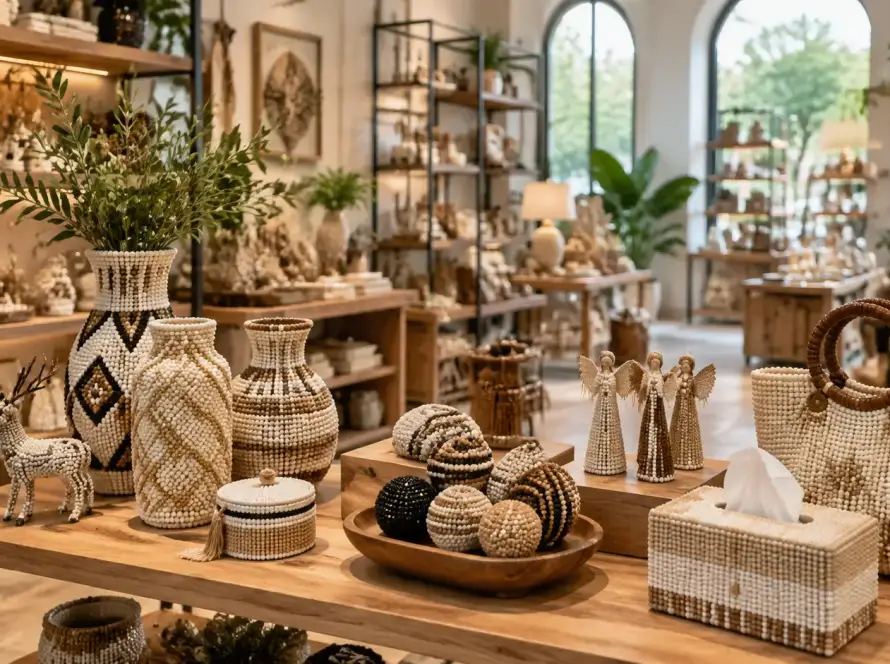
Vases are leading the beaded decor category into 2027, and for good reason. A beaded vase does double duty as a display object on its own and as a vessel for dried or faux florals, which makes it easy for customers to justify the purchase and easy for retailers to merchandise near seasonal floral displays.
What’s shifted is the shape language. Instead of simple round forms, buyers are gravitating toward sculptural silhouettes — fluted, faceted, and asymmetric profiles that catch light differently depending on the bead color and finish. These pieces work as standalone art objects on a console table even without flowers in them, which widens the customer base beyond people who buy fresh florals regularly.
For retailers, vases are also one of the easiest beaded decor SKUs to merchandise across multiple customer types: home decor shoppers, florists and event planners looking for reusable centerpieces, and hospitality buyers furnishing hotel lobbies or restaurant tables. A single vase design can sell into three different channels without any changes to the product itself.
- Retail takeaway: place vases near your seasonal floral or event-decor section, and consider offering two or three size options so customers can buy as a set.
III. Trend 2 — Novelty & Animal-Shaped Tabletop Pieces
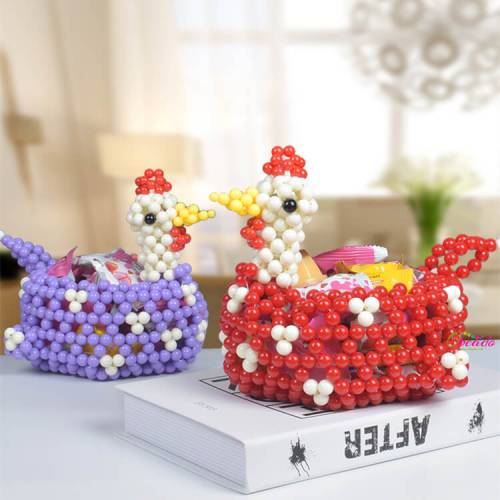
If vases are the elegant end of the category, novelty pieces are the fun end — and they’re driving a surprising amount of 2027’s growth. Animal-shaped candy trays, whimsical pen holders, and playful tabletop accents are turning up in gift shops, boutique offices, and “cute maximalism” home displays alike.
Think peacock- and butterfly-shaped candy trays, bicycle- and shoe-shaped pen holders, or a hexagon tray that still manages to feel personality-driven rather than generic. These pieces work because they’re conversation starters: a customer doesn’t buy a chicken-shaped candy dish because they need a candy dish — they buy it because it makes them smile every time they walk past it.
This trend also has a useful crossover for retailers: many of these pieces sell just as well as desk accessories as they do as home decor. A pen holder that looks great on a home office desk photographs equally well in a corporate gift catalog, which means one SKU can serve two very different buyer intents — home decor shoppers and corporate or promotional gift buyers — without any additional development cost.
- Retail takeaway: novelty pieces perform well as impulse buys near checkout, and as a starter category if you’re testing beaded decor for the first time before committing shelf space to larger pieces.
IV. Trend 3 — Beaded Fruit & Nature Motifs
Nature-inspired shapes — pineapples, fruit-form ornaments, floral motifs — are carrying real momentum into 2027, tied to a broader interior trend toward coastal, tropical, and “kitchen decor as display” aesthetics. A beaded pineapple ornament or fruit tray sits comfortably on a kitchen counter or open shelf in a way that feels seasonal without being tied to a single holiday, which gives it a longer shelf life than most novelty decor.
These pieces also do well in hospitality and food-service-adjacent retail. A restaurant or café sourcing tabletop accents wants something that feels warm and handmade rather than clinical, and fruit and nature motifs hit that note without competing visually with the food itself. For retailers already serving restaurant, hotel, or B&B clients, this trend is worth stocking as a standing category rather than a seasonal one-off.
From a merchandising standpoint, fruit and nature motifs also pair naturally with the vase trend above — a beaded fruit tray and a sculptural vase share a color palette easily, which makes cross-selling a two-piece “tablescape” bundle straightforward.
- Retail takeaway: bundle a fruit tray with a vase in the same color family and merchandise them together as a ready-made tablescape gift set.
V. Trend 4 — Pearl-Tone Decor (Quiet Luxury Crossover)
“Quiet luxury” has dominated fashion and home decor conversations for a couple of years now, and beaded decor is picking up its own version of the trend: pearl-toned finishes. Warm ivory, champagne, and soft cream bead work reads as understated and premium rather than colorful and playful, which appeals to a different customer than the novelty pieces above.
Pearl-tone pieces tend to sell into a slightly higher price bracket and a more design-conscious buyer — someone furnishing a full room around a neutral palette rather than shopping for a single fun accent. For retailers who already carry pearl-finish bags or accessories, extending that same pearl aesthetic into home decor SKUs like trays and vases is a natural next step, and one worth raising directly with your manufacturer even if it isn’t a standard catalog listing — pearl-tone finishes can often be produced as a custom order.
This trend also travels well internationally. A neutral, pearl-toned piece tends to suit a wider range of interior styles — from US and Canadian homes to European and Australian ones — than a heavily colored novelty piece does, which makes it a comparatively safe SKU to test when you’re entering a new export market.
- Retail takeaway: position pearl-tone pieces as a premium tier next to your standard-color beaded decor, rather than mixing them into the same display.
VI. Trend 5 — Beaded Figurines as Shelf/Gift Decor
Figurines sit at the intersection of home decor and gifting, and that dual identity is exactly why they’re worth stocking. A beaded elephant or other figurine works as a standalone shelf piece for a home decor customer, and as a ready-made gift for a customer who walked in without a specific decor need at all.
This matters more for gift shop and boutique retailers than for pure home decor stores, because figurines convert browsers into buyers even when the customer wasn’t originally shopping for decor. They’re also low-risk from a merchandising standpoint — small footprint, easy to display in volume near a checkout counter, and priced accessibly enough to work as an impulse add-on rather than a considered purchase.
For retailers building out a beaded decor section from scratch, figurines are often the easiest entry point: they require less shelf space than vases or trays, and they let customers “try” the category at a lower price point before committing to a larger statement piece.
- Retail takeaway: use figurines as your lowest-friction way to introduce beaded decor to customers, then upsell into vases or trays once the category proves itself.
VII. What Retailers Should Ask Suppliers Before Buying
Not every supplier offering beaded home decor is set up to serve retail buyers well. Before you commit to a wholesale order, it’s worth working through a short checklist — the answers will tell you a lot about how the rest of the relationship is likely to go.
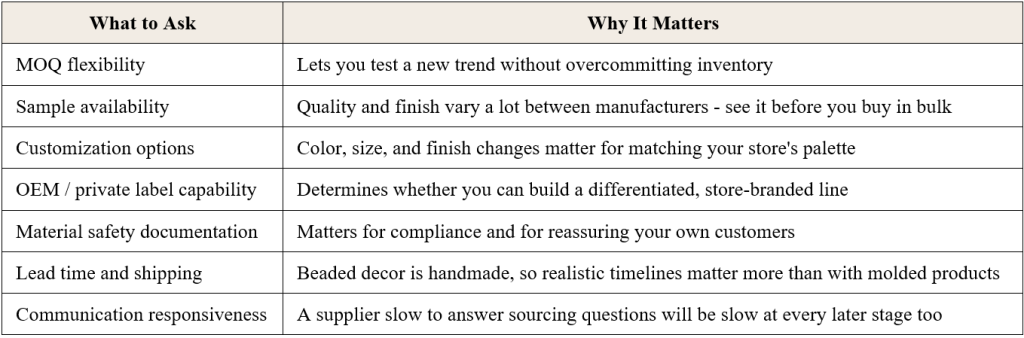
Sourcing home decor with beads from China is still the most common route for retailers building out this category, simply because that’s where most of the skilled handwork and bead supply chains are concentrated. The tradeoff is that not every factory is equipped to handle custom home decor with beads requests or small-batch retail orders — many are set up for large industrial runs only. Vetting for MOQ flexibility and sample availability up front saves a lot of back-and-forth later.
On the safety and documentation front, don’t just take a verbal assurance. A supplier worth working with should be able to point you to a published safety and suitability reference for their products — covering intended use, age suitability, and product care — rather than leaving it to you to draft that language yourself for your own store.
VIII. Frequently Asked Questions
1. What are beaded home decor pieces typically made from?
Most beaded home decor — vases, trays, ornaments, and figurines — is built from small acrylic or glass-style beads strung and shaped over a frame, usually with nylon fishing line. The material is lightweight, colorfast, and holds detailed shapes well, which is why it works for everything from sculptural vases to animal-shaped novelty pieces.
2. Is beaded home decor considered safe for general retail resale?
These are decorative items, not toys, and reputable manufacturers will say so directly — some pieces contain small parts and aren’t intended for children or pets. Ask any supplier for their published safety and suitability guidance before listing products, and pass relevant care and age-suitability information on to your own customers.
3. What’s a realistic minimum order quantity for wholesale beaded home decor?
This varies by manufacturer, but factories set up for retail buyers — rather than only large industrial accounts — typically offer low MOQs and paid samples so you can test a design before committing to a bulk order. If a supplier can’t offer a sample or insists on a very high minimum, it’s worth continuing to compare options.
4. Can beaded home decor be customized or private-labeled?
Yes, in most cases. Color, size, and finish adjustments are common OEM requests, and some manufacturers can also support private-label packaging or branded inserts. It’s worth confirming customization turnaround time separately from standard lead times, since custom runs usually take longer.
IX. Recommended Supplier of Home Decor with Beads
Beaded home decor isn’t a passing seasonal fad — it’s a category that’s been building steadily and is positioned to accelerate through 2027 as maximalist, handmade interiors keep gaining ground over mass-produced minimalism. Vases, novelty tabletop pieces, nature motifs, pearl-tone accents, and figurines each appeal to a slightly different customer, which means a retailer can build a genuinely broad beaded decor section rather than a single narrow SKU line.
The retailers who benefit most will be the ones who move early, vet their suppliers carefully, and treat home decor with beads design as a real merchandising category rather than a one-off trend purchase. Whether you’re sourcing your first sample or expanding an existing beaded decor line, starting with a manufacturer who understands both the craft and the retail side of the business will make the difference.
Obeado has been manufacturing handmade home decor with beads since 2011, starting as a single-person bead craft workshop and growing into a full factory model based in Guangxi, China, that now works with a network of skilled home-based artisans. That history matters for retailers: it means every piece still carries the handmade quality of the original workshop, but at a production scale that can actually support wholesale orders.
Obeado Crafts Co., Ltd.
Web: https://obeado.com/
Email: sales@obeado.com