If you’ve sourced from China before, you already know the product isn’t usually the hard part. The hard part is getting that product across an ocean, through customs, and onto your shelves on the date you promised your own customers. That’s where a lot of supplier relationships get tested, and it’s honestly where a lot of them fall apart.
At Obeado, we’ve been making handmade beaded crafts since 2011 — beaded bags, figurines, vases, home décor, Christmas ornaments, and corporate gifts, mostly for gift shops, hotels, event planners, and retail brands across the US, Canada, Europe, and Australia. Shipping isn’t something we figure out after the fact. It’s part of how every order is planned from day one.
This guide walks through how we actually ship: air versus sea, what to expect region by region, how our production schedule fits into your delivery date, how we pack fragile handmade pieces so they survive a month at sea, and what you can do on your end to keep things moving. If you’re weighing us up as a supplier, or you’ve already placed an order and want to know what happens next, this should answer most of it.
I. Our Shipping Options: Air vs. Sea Freight
Every order we ship goes out one of two ways, and which one makes sense really comes down to how much you’re ordering and how soon you need it.
Samples: always by air
If you’re testing us out or checking a new design before committing to a bulk order, your sample goes out by air courier — DHL, FedEx, or a similar service. There’s no scenario where a sample order should sit on a container ship for a month, so we don’t do that. Most samples arrive within a week of dispatch.
Bulk orders: air or sea, your call
Once you’re placing a wholesale order, you have a real choice to make. Air freight gets your goods there faster but costs more per unit. Sea freight costs a fraction of that per unit but needs weeks of lead time, not days. Neither is “better” — it depends on your order size, your budget, and how much runway you’ve got before you need stock on your shelves.

As a rule of thumb: if you’re restocking in a hurry or testing a small batch in a new market, air is worth the extra cost. If you’re placing a full container order for a season you’ve already planned around — think Q4 holiday stock — sea freight is almost always the better economics.
II. Shipping to the United States
The US is one of our largest markets, and most orders route through West Coast ports like Los Angeles and Long Beach, since that’s the fastest transpacific lane. Some buyers on the East Coast prefer routing through New York or Savannah instead, which adds a bit of transit time but can save on inland trucking depending on where your warehouse sits.
- Sea freight: roughly 25–35 days port to port, plus several more days for customs clearance and inland trucking to your warehouse.
- Air freight: typically 5–8 days door to door.
US buyers mostly order beaded bags, home décor pieces, and Christmas crafts for gift shops, boutiques, and event planning companies. Because Christmas items are so seasonal, we always tell buyers to place holiday orders well ahead of Q4 — factor in our production time plus sea freight, and you’re looking at a couple of months minimum from order confirmation to product on your shelves.
On the customs side, standard US import duties apply based on the HS code for beaded crafts, so it’s worth building that into your landed cost math early rather than as an afterthought. We provide the commercial invoice and packing list your customs broker will need to clear the shipment.

III. Shipping to Canada
Canadian orders typically move through the Port of Vancouver for sea freight, though some buyers route via a US port of entry and truck goods north from there. Air freight lands at major hubs like Toronto or Vancouver directly.
- Sea freight: around 30–40 days, depending on your final destination within Canada.
- Air freight: roughly 6–9 days.
Canadian import duties and GST/HST are assessed separately from US duties, so if you’re managing distribution for both countries, don’t assume one customs calculation covers the other. Your customs broker will need the same documentation package we provide for US shipments.
IV. Shipping to Europe
Europe is a bit more varied simply because “Europe” covers a lot of ports and a lot of different customs regimes. Most of our sea freight into the EU comes through Rotterdam, Hamburg, or Antwerp, and UK-bound orders typically go through Felixstowe or Southampton.
- Sea freight: generally 30–45 days depending on the destination country and whether goods need to move on from the port by truck or rail.
- Air freight: usually 5–8 days.
One thing worth flagging for European buyers specifically: VAT and duty rates differ by member state, and post-Brexit, the UK is handled as a fully separate customs process from the EU. If you’re distributing to multiple European countries from one warehouse, it’s worth checking with your customs broker about where you actually want goods to clear first.
V. Shipping to Australia
Australia tends to be a bit more straightforward on the transit side. Sea freight comes into Sydney, Melbourne, or Brisbane, and thanks to established shipping lanes across the Pacific, transit times are often a little shorter than what we see to the US or Europe.
- Sea freight: roughly 20–30 days.
- Air freight: typically 5–7 days.
Australian customs and biosecurity checks are thorough, so accurate product descriptions and packing lists matter more here than in some other markets — it’s not that beaded crafts raise red flags, it’s that incomplete paperwork is what causes hold-ups at the border. Australian buyers order across the same categories as everywhere else, though we do see stronger demand for beaded home décor and corporate gift items outside the typical Christmas rush.

VI. Production & Lead Times Before Shipping
Your total delivery time isn’t just the shipping transit — it’s production time plus shipping time, and it’s worth planning around both.
- Regular, off-the-shelf products: about 15 days in production.
- Customized orders (your own design, colors, or packaging): 20–30 days in production.
Put those numbers next to the shipping times above and you get a realistic total. A regular product order going by sea to the US, for example, is roughly 15 days of production plus 25–35 days of shipping — call it 6 to 7 weeks from order confirmation to arrival. A custom order going by air to Australia might be closer to 4 to 5 weeks total. If you’re planning around a specific date — a holiday season, an event, a store opening — work backward from that date using these numbers, and build in a little buffer. Freight schedules slip sometimes, and it’s easier to have a cushion than to explain a late shipment to your own customers.
VII. Packaging & Quality Assurance for Long-Distance Shipping
Handmade beaded pieces are, by nature, more delicate than injection-molded products, so packaging isn’t something we treat casually. A beaded vase or figurine that looks fine on the workbench can arrive in pieces if it’s not packed properly for a month at sea.
- Each piece is individually wrapped — poly bag plus bubble wrap or foam, depending on shape and fragility.
- Fragile items (figurines, vases, ornaments) get extra cushioning and corner protection inside the carton.
- Export-grade cartons are used for all bulk shipments, sized and reinforced for the product inside rather than a one-size-fits-all box.
- Quality checks happen at multiple points — after production, before packing, and again before the shipment leaves our facility.
If you want visual confirmation before your order ships, just ask — we can send photos or a short video of the packed goods prior to dispatch, which a lot of our first-time buyers find reassuring.
VIII. Working with Obeado: MOQ, Payment, and Ordering Process
We keep our minimums low on purpose. A lot of buyers come to us wanting to test a new product line or a new market without committing to a huge order upfront, and low MOQs make that possible.
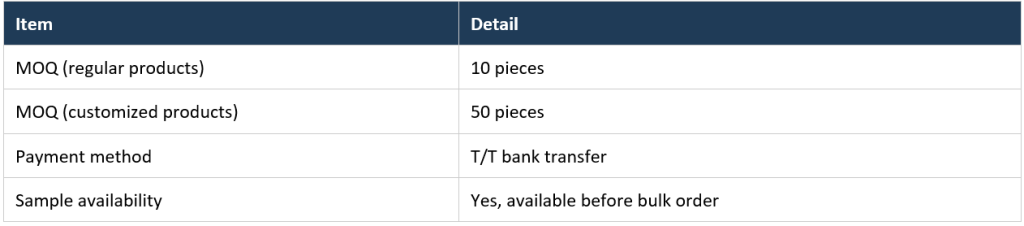
The typical process looks like this: you send an inquiry with the products or design you’re interested in, we quote pricing and confirm MOQ, you order a sample to check quality in person, and once you’re happy, we move to the bulk order — deposit, production, balance payment, then shipment. It’s a fairly standard process, but the low MOQ is what makes it low-risk if you’re not yet sure how a product will sell in your market.

IX. Tips for International Buyers to Avoid Shipping Delays
Most shipping delays we see aren’t caused by the freight itself — they’re caused by something that could have been sorted out before the goods ever left the factory. A few things worth getting right on your end:
- Double-check your shipping address and consignee details before we book the freight. A wrong or incomplete address is one of the most common causes of hold-ups at destination.
- Understand your Incoterm (EXW, FOB, or CIF) and who’s responsible for which leg of the journey. If you’re not sure which one fits your setup, ask us — we’re happy to walk through it.
- Avoid placing orders right before Chinese New Year without padding your timeline. Factories across China, including ours, typically close for two to three weeks around late January or February, and that backs up production schedules on both sides of the holiday.
- Order ahead of your peak season, not during it. If you need stock for Q4, place the order in summer, not October.
- Have your customs broker or import documentation ready before the shipment arrives, so goods aren’t sitting at port waiting on paperwork.
- Finalize product specs and quantities before production starts. Changes requested mid-production are the single biggest cause of schedule slippage on our end.
X. How to Work with Obeado?
Getting started is simple. Reach out with the products you’re interested in, or send us reference images if you have a custom idea in mind. We’ll come back with pricing and MOQ, and from there you can order a sample to check quality before committing to a bulk order.
- Email us at sales@obeado.com with your product interest or design idea.
- We’ll quote pricing, MOQ, and estimated lead time.
- Order a sample to confirm quality and design before your bulk order.
- Once approved, place your bulk order and choose air or sea freight based on your timeline.
You can also browse our full product range at obeado.com/products or get in touch directly through our contact page.
Obeado Crafts Co., Ltd.
Web: https://obeado.com/
Email: sales@obeado.com